

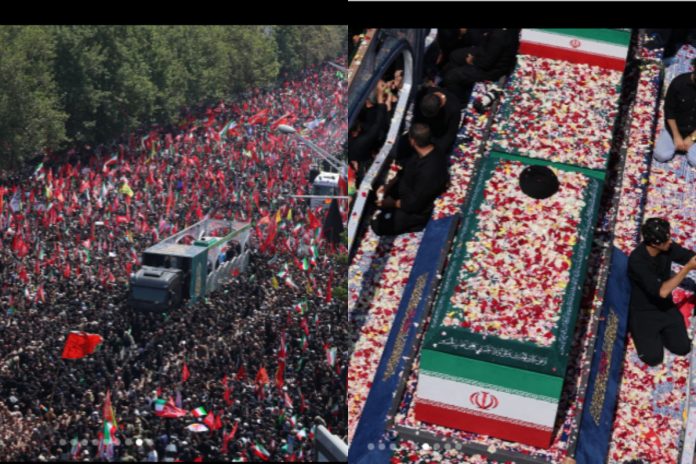
Iran on Thursday buried its slain Supreme Leader Ayatollah Ali Khamenei at the Shrine of Imam Reza in Mashhad, the country’s holiest shrine. His son and successor, Mojtaba Khamenei, remained out of public view after reportedly suffering severe injuries in the strike that killed his father.
The burial took place after a week of funeral processions, rallies and mourning ceremonies across Iran and Iraq. These events came as tensions with the United States resurfaced following weeks of truce.
Thousands of mourners gathered in Mashhad, where the shrine’s golden dome and minarets stood out in the morning sunlight. People carried Iranian flags, portraits of the late Khamenei and banners displaying revolutionary slogans.
During the past week, Khamenei’s body was taken through several cities in Iran and Iraq. Religious leaders encouraged large public turnouts to demonstrate the Islamic Republic’s strength and ideological commitment.
Read Also: UK braces for third heatwave as temperatures near 35°C
Despite surviving months of conflict with the United States and Israel, Iran continues to face domestic challenges, and opinions remain divided over Khamenei’s 37-year leadership.
Mojtaba Khamenei, who was declared the new supreme leader by a clerical assembly a week after his father’s death, has not appeared in public since the conflict began with the strike that killed Ali Khamenei on February 28.
Although he has released written statements, no photographs, videos or audio messages have been made public. Reports say he suffered serious injuries in the same attack, leaving his face disfigured and his limbs badly wounded.
Senior officials in Tehran said he is recovering but is not yet fit for public appearances. Security authorities are also limiting his public exposure because of concerns over possible future US attacks.
As mourners waited for the funeral procession in Mashhad, crowds chanted slogans calling for revenge against US President Donald Trump.
“I swear by the blood of the supreme leader, Trump, we will kill you!” they shouted, while some women held placards reading “Kill Trump”.
Before the burial, the remains of Khamenei and four family members who were killed alongside him were carried through Tehran, the religious city of Qom and the Iraqi shrine cities of Najaf and Karbala.
Large crowds attended each procession, where mourners listened to religious laments and chanted revolutionary slogans.
Martyrdom has long held an important place in Islamic theology, and Khamenei’s death at the hands of foreign enemies has reinforced a religious and political tradition deeply rooted in the Islamic Republic.
The funeral marks a major turning point for Iran after nearly four decades of Khamenei’s leadership. It also comes months after another wave of nationwide protests against the Islamic Republic, which officials said were backed and encouraged by foreign powers.
The protests were driven by public frustration over the sanctions-hit economy. Security forces eventually brought the unrest under control, though many protesters lost their lives.
Analysts believe Iran emerged from the conflict with its control over the Strait of Hormuz intact. However, the country also suffered extensive damage from US and Israeli strikes on civilian and oil infrastructure, adding further pressure to its economy.
Khamenei became supreme leader in 1989, a decade after the Islamic Revolution. During his time in power, he steadily expanded political, economic and military authority under his office.
His leadership increasingly reduced the influence of the elected president and parliament while strengthening the role of the Islamic Revolutionary Guard Corps, which became a central force in Iran’s political and strategic affairs.
Mojtaba Khamenei was appointed with the support of the Revolutionary Guards, who are now widely viewed as the dominant force in Iran’s political and strategic decision-making.