


ISLAMABAD: All public and private offices along with schools located in the Red Zone have been directed to shift to online operations, while government offices in the capital have moved to remote working after authorities sealed entry points to the Red Zone from Monday. The move comes ahead of the expected next round of US-Iran talks in Islamabad.
Pakistan recently played a key role by helping arrange a 14-day ceasefire between the US and Iran. This was followed by important talks in Islamabad attended by senior delegations from both countries.
Although those talks did not produce the expected outcome, the ceasefire is still in place and efforts are continuing to build trust and move towards a lasting peace agreement.
Another round of talks is expected in Islamabad after US President Donald Trump announced on April 19 that representatives from the United States would arrive in the capital on April 20.
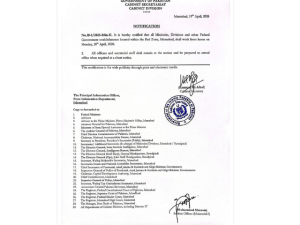
According to an official notification, “all ministries, divisions and other federal government establishments located within the Red Zone Islamabad shall work from home on Monday, April 20.”
Read Also: Heavy, public transport suspended in Islamabad and Rawalpindi
The notice further stated that “all officers and secretarial staff shall remain at the station and be prepared to attend office when required at short notice,” with the Cabinet Secretariat issuing the instructions late Sunday night.
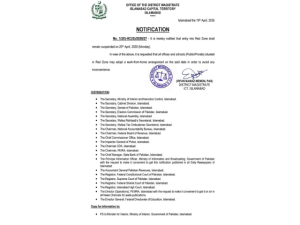
In a separate order, Islamabad Capital Territory District Magistrate Irfan Nawaz Memon announced that “entry into the Red Zone shall remain suspended on April 20 Monday,” and requested that “all offices and schools, public and private, situated in the Red Zone may adopt a work-from-home arrangement to avoid any inconvenience.”
An Islamabad Police spokesperson said that starting April 20, licensing services would only be available at Police Facilitation Centres located in F-6, Gulberg Greens and the Diplomatic Enclave. Services at other centres, including the Faizabad Traffic Headquarters, will remain closed until further notice.
Citizens have been advised to follow official instructions and stay informed through the Islamabad Traffic Police’s WhatsApp channel, social media pages and ITP FM 92.4.
On Sunday, Memon confirmed that heavy and public transport services across Islamabad had been suspended. He stated that all “Heavy transport and public transport in the city are being suspended until further notice.” Rawalpindi Deputy Commissioner Hassan Waqar Cheema also issued a similar order, announcing that all private, public and goods transport services in Rawalpindi would remain suspended as a precaution due to the upcoming talks.
These strict measures have affected daily life in both Islamabad and Rawalpindi. With public transport halted on Sunday, many passengers were left stranded. People travelling to other cities had to wait for long hours at bus terminals, while many turned to railway services as an alternative.
Railway stations experienced heavy crowds due to the increased demand. The Karachi to Peshawar Khyber Mail faced a delay of three hours, yet passengers continued to wait in large numbers.
The Metro Bus Authority also announced that the Red Metro Bus Service in the Twin Cities has been completely suspended. The service between Saddar Station in Rawalpindi and Pak Secretariat Station in Islamabad will remain closed until further notice.
Authorities stated that these steps are part of major security arrangements in the federal capital due to the high-level diplomatic talks, aiming to maintain safety and order.
Security arrangements
Rawalpindi police have been placed on high alert, with more than 10,000 personnel deployed across the city. Over 600 special pickets have been set up, and strict checking is being carried out at all entry and exit points. Senior officers, including SSP Operations Malik Tariq Mehboob and divisional SPs, are supervising operations.
Security has also been strengthened in Islamabad, where police personnel have been instructed not to use mobile phones while on duty and to wear anti-riot equipment.
City Police Officer Khalid Hamdani is overseeing operations, with elite commandos, snipers and quick response units, including the Elite Force and Dolphin Force, deployed in sensitive areas. Around 18,000 personnel, including reinforcements from Punjab, are expected to take part.
Islamabad Police, Pakistan Rangers and the Frontier Corps will jointly manage security checkpoints.
Authorities have also directed that only properly identified personnel be allowed on duty routes, which will remain clear during official movements. Hostels, hotels and guest houses have been instructed to shut until further notice, with warnings of legal action for those who fail to comply. Authorities are also considering closing seminaries located near high-security zones.
Alternative traffic plan
Officials have announced that the Red Zone and Extended Red Zone will remain completely closed to all traffic. The Islamabad Expressway between Koral and Zero Point will remain closed, while Srinagar Highway may face temporary closures at different times during the day. Residents have been urged to follow diversion plans if roads are blocked.
Islamabad Police have also closed the entry at Jinnah Avenue near Khyber Plaza, while Club Road has been sealed from Kashmir Chowk.
Read Also: German Embassy suspends visa services in Islamabad for two days
Under the traffic plan, residents of Sectors G-5, G-6, G-7, F-6 and F-7 can use Margalla Road and 9th Avenue to travel between Islamabad and Rawalpindi. Traffic moving from Faisal Avenue towards Zero Point will be diverted to 9th Avenue.
If the road between Zero Point and Koral Chowk is closed, vehicles will be redirected through Srinagar Highway to 9th Avenue, then towards Stadium Road, Murree Road at Chandni Chowk and Rawal Road leading to Koral.
If the route between Park Road and Club Road is shut, traffic will be diverted towards Taramri Chowk.
Traffic police have been deployed at several locations to guide citizens and manage the flow of vehicles.