

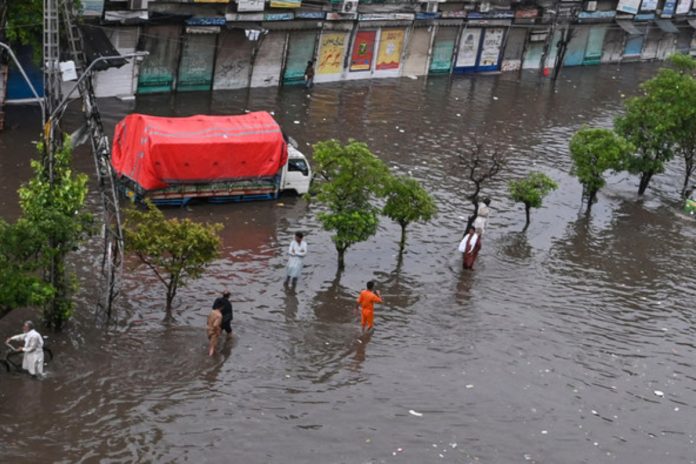
The National Emergency Operations Center (NEOC), working under the National Disaster Management Authority (NDMA), has issued a public advisory ahead of expected moderate to heavy monsoon rains set to impact different parts of the country from Sunday, July 13, to Tuesday, July 17, 2025.
According to the advisory, a combination of strong moisture coming in from the Bay of Bengal and the Arabian Sea, along with an active westerly system, is likely to cause significant rainfall in many areas of Pakistan during this period.
This weather pattern is expected to cause a noticeable rise in river water levels, especially in the Indus, Kabul, Jhelum (upstream of Mangla), and Chenab rivers.
Currently, water levels at the Tarbela, Taunsa, and Guddu barrages are considered low, while Kalabagh and Chashma are already seeing medium flood levels.
Taunsa is likely to reach a medium level soon, and low to medium flows are predicted to continue in the Indus River channels throughout the week.
At Marala and Khanki, the Chenab River is expected to reach low flood levels. The River Kabul at Nowshera is also forecast to rise.
Additional pressure from rainfall is likely in the River Swat and River Panjkora, along with their nearby streams and channels.
There’s also a strong chance of medium to high water flow in hill torrents across D.G. Khan and Rajanpur.
In Balochistan, particularly in the northeast regions such as Jhal Magsi, Kachhi, Sibi, Qila Saifullah, Zhob, and Musakhel, stream levels may surge significantly.
The southern parts of the province, including Khuzdar, Awaran, Lasbela, and Qalat, may also face flash flooding. Currently, Tarbela Dam stands at 74% of its capacity, while Mangla Dam is at 44%.
NDMA has urged residents living near rivers, streams, and drains to remain cautious, especially at night or during heavy rainfall.
People in areas disposed to to flooding should map out safe evacuation routes, shift valuable belongings and livestock to higher ground, and prepare emergency kits with basic items like food, water, and medicines to last several days.
District authorities, especially in central and northeastern Punjab, have been told to ensure that dewatering machinery is ready to tackle possible urban flooding.
Citizens are advised to stay informed by following official flood alerts via television, radio, mobile text updates, and the Pak NDMA Disaster Alert app.
Everyone is strongly warned against attempting to cross causeways, submerged roads, or low bridges. NDMA is closely coordinating with all concerned departments to monitor the evolving situation and issue timely updates.