

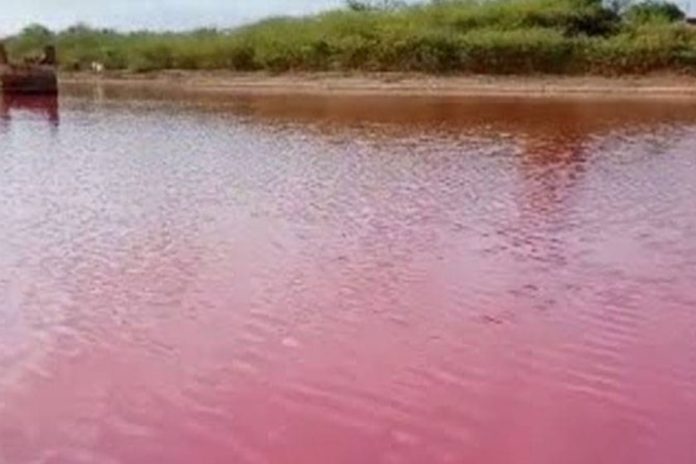
A rare and unusual event recently occurred at Gadani Jetty, once known for its clear blue waters, which suddenly turned into a pink, foul-smelling wetland.
Scientists from the National Institute of Maritime Affairs (NIMA) investigated the matter after media reports caught the attention of President NIMA, who directed the Karachi Chapter to conduct an on-site survey and collect water samples for laboratory analysis.
The incident drew significant attention from marine experts, the public, and online communities.
NIMA’s team inspected the area, assessing the water’s odour and visible changes, and preserved samples for detailed laboratory testing. Dead fish were also found in certain locations.
Marine scientists identified the phenomenon as a “pink tide,” caused by blooms of pigment-producing microorganisms such as halophilic bacteria or algae.
These organisms release natural pigments in shades of pink, red, green, or yellow, depending on environmental conditions.
Such events have been recorded in various parts of the world, including Australia, the United States, the Mediterranean, and Southeast Asia.
In Pakistan, this is the third documented occurrence; earlier ones happened near Karachi in 2017 and along the Makran coast in 2021.
Laboratory results revealed extreme environmental changes in the lagoon. The seawater temperature was recorded at 36.5°C, much higher than the normal 24.5°C to 29.5°C in coastal waters.
Salinity reached 48 parts per thousand (PPT) compared to the usual 35 PPT. Turbidity was at 47 NTU, far above the typical 1–5 NTU.
Nutrient levels were also excessive, Ammonium at 2.256 mg/L and Phosphate at 5.739 mg/L, creating ideal conditions for bacteria and algae to multiply.
The water’s pH was slightly acidic at 6.94, while total dissolved solids (TDS) and conductivity were also far beyond normal ranges.
Experts concluded that the lagoon’s faulty jetty design had restricted water circulation, causing higher salinity and temperature while trapping nutrients.
These factors allowed color-producing microbes to thrive, a situation unlikely to occur in open waters where natural currents dilute such concentrations.
NIMA warned that harmful algal blooms (HABs) can cause health problems such as skin irritation and, in some cases, toxins that contaminate seafood.
They advised avoiding direct contact with the water, swimming, or consuming seafood from affected areas until safety is confirmed by authorities.
The team recommended that the Balochistan Environmental Protection Agency (BEPA) immediately enforce safety protocols and that jetty design modifications be made to restore proper water flow.
President NIMA Vice Admiral Ahmed Saeed HI(M) (Retd) stressed that protecting coastal communities and preserving marine ecosystems must remain a top priority at both provincial and national levels.