

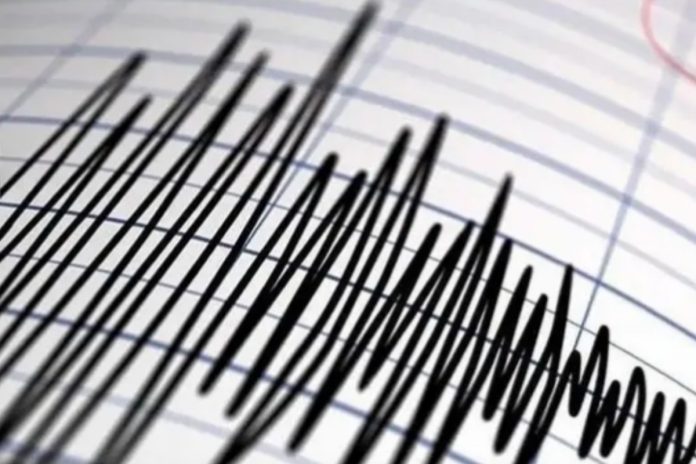
KARACHI: A mild earthquake was felt in parts of Karachi on Wednesday morning, creating brief concern among residents in Malir and nearby areas.
The Pakistan Meteorological Department (PMD) reported that the tremor struck at 9:34am, measuring 3.2 on the Richter scale at a depth of 10 kilometers. Its epicenter was located about 7 kilometers northwest of Malir, at coordinates 24.93°N and 67.16°E.
People in Malir and surrounding localities experienced light shocks, but no damage or injuries have been reported. Many residents stepped out of their homes and offices for safety.
The PMD stated that the situation is under observation and reminded that Karachi, though not on a major fault line, is still prone to mild to moderate seismic activity. Authorities have asked citizens to stay calm and follow safety guidelines during such events.
Earlier in June, two earthquakes had shaken Karachi, one with its epicenter in DHA and the other in Malir.
According to Ameer Haider Laghari, Director of the National Tsunami Centre at the Meteorological Department, the Landhi fault line could remain active for a few days after the tremor.
He explained that movements in underground tectonic layers release energy over time, leading to such recurring quakes.
He added that these tremors are not signs of a major disaster but rather part of a natural geological process that may eventually help stabilize the local fault line.
The first earthquake of this year in Karachi was recorded on March 31, with a magnitude of 4.7 and a depth of 19 kilometers. Tremors were felt across various areas of the city.
Laghari assured that earthquakes in Karachi remain low in intensity and that each tremor has been weaker than the last.
He also clarified that these are not aftershocks, since such minor quakes usually occur independently. He pointed out other active fault lines in the region, including Landhi, Thana Bula Khan, and the Western Kirthar Range Plate Foundry Fault Line.
As a safety measure, he advised residents of weak structures to evacuate quickly during tremors and move to open spaces rather than standing near walls.
Adding a broader perspective, Dr. Adnan Khan, Associate Professor and Geologist at the University of Karachi, told that these tremors are minor and not a cause for worry.
He explained that Karachi lies on a passive tectonic margin, far from any major fault line, which makes strong and destructive earthquakes highly unlikely.
“These tremors are classified as mild, resulting from minor tectonic movements and stress accumulation deep within the Earth’s crust,” Dr. Khan said.
He further linked these small movements to the Himalayan tectonic activity, where the mountain range continues to shift northward by 4 to 5 centimeters each year.
This movement creates tectonic pressure that can occasionally cause low-intensity tremors in distant areas such as Karachi.