

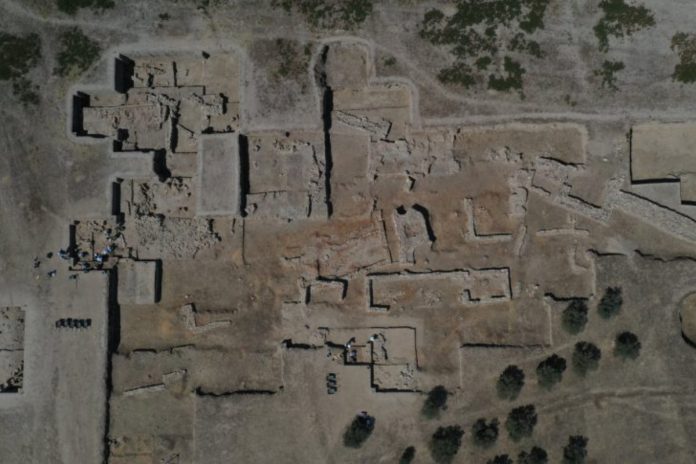
Archaeologists in Kuwait have discovered a 4,000-year-old temple belonging to the ancient Dilmun civilization on Failaka Island. Authorities have described the find as one of the most important archaeological discoveries in recent decades, according to Al Qabas.
The National Council for Culture, Arts and Letters (NCCAL) announced the discovery on Sunday. A joint Kuwaiti–Danish team from the Moesgaard Museum unearthed the temple during the 2025 excavation season.
Mohammed bin Redha, Acting Assistant Secretary-General for the Antiquities and Museums Sector at NCCAL, said the excavation team uncovered the complete layout of a Bronze Age temple hidden beneath another Dilmun temple discovered last year.
Both temples date back nearly 4,000 years, confirming that two sacred structures were built on the same spot, one over the other.
He added that NCCAL remains committed to supporting excavation, preservation, and research projects aimed at safeguarding Kuwait’s ancient heritage.
The excavation site lies east of the Dilmun palace and temple at Tell F6, a mound linked to early Dilmun history.
Dr. Stefan Larsson, head of the Danish mission, said earlier excavations had uncovered parts of a temple platform dating to around 1900 BCE.
The newly found structure beneath it included foundations, seals, and pottery vessels. He said the discovery marks an important step toward understanding the religious traditions of the Dilmun civilization.
Kuwait University archaeologist Dr. Hassan Ashkanani described the discovery as “a remarkable archaeological milestone.” He said that the presence of two temples from 1900–1800 BCE provides valuable insight into the religious and civic architecture of ancient Dilmun.
With this discovery, the total number of known temples in the island’s southwest has risen to four. Experts believe this area once served as a major administrative and spiritual hub during the Bronze Age.
Dr. Ole Herslund, who has supervised excavations since 2022, said that researchers will now conduct detailed analyses of both temples, including their architecture and ritual activities, to better understand how religion and politics influenced life in Dilmun society.
Failaka Island, located about 20 kilometers off Kuwait’s coast, was once a thriving center of the Dilmun civilization, which flourished across the Gulf region during the Bronze Age.