

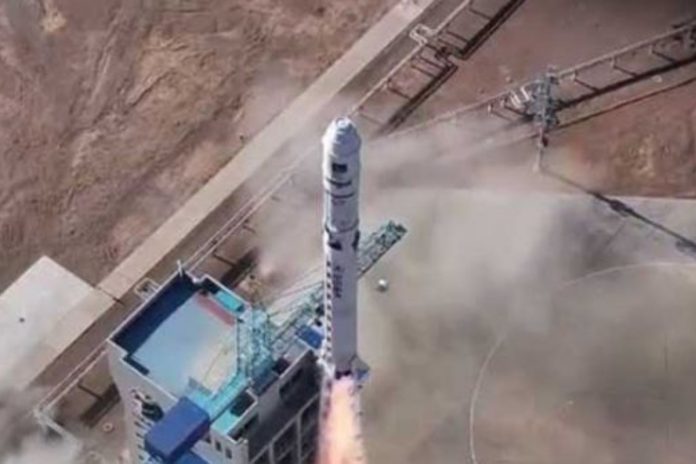
Pakistan on Sunday successfully launched its first hyperspectral satellite, HS-1, from China’s Jiuquan Satellite Launch Centre, marking a major milestone in the country’s space program, according to Suparco.
Unlike regular satellite cameras that capture only a few broad color bands, hyperspectral sensors record hundreds of narrow spectral channels, allowing scientists to detect subtle variations in vegetation, soil, and water composition.
Experts say this technology is particularly useful for precision farming, environmental monitoring, and resource mapping.
Suparco stated that HS-1 will capture highly detailed spectral images across multiple bands, helping to better analyze crop health, soil moisture, and water quality.
The satellite will also assist in tracking deforestation, pollution, and glacier melt, while improving early warning and post-disaster assessments for floods, landslides, and other natural calamities, especially in Pakistan’s northern regions.
Officials noted that HS-1 will support major infrastructure projects by identifying geo-hazard risks and aiding safer development along key routes, including the China-Pakistan Economic Corridor (CPEC).
Suparco Chairman Muhammad Yousaf Khan thanked the federal government for its support, saying the data from HS-1 would enhance agricultural productivity, strengthen climate resilience, and improve natural resource management.
Project Director Mushtaque Hussain Soomro called the launch a significant step forward in Pakistan’s space roadmap, emphasizing that it will expand space-based services for sustainable development and disaster response.
The Foreign Office described the launch as a “pivotal advance” in Pakistan’s space ambitions and praised the collaboration between Pakistani and Chinese technical teams. Foreign Minister Mohammad Ishaq Dar also lauded their commitment and the success of the joint effort.
Suparco had earlier announced the HS-1 launch plans in mid-October, noting that it is increasingly using satellite technology to enhance disaster risk management and emergency response across the country.