

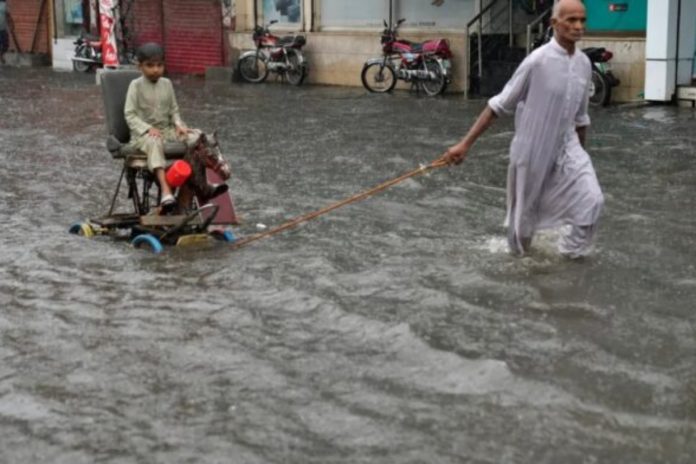
The National Disaster Management Authority’s (NDMA) National Emergency Operations Centre (NEOC) has issued an alert for heavy rains and possible flooding in different parts of Pakistan from August 23 to 30, urging both authorities and the public to stay vigilant.
According to the NEOC, three weather systems are expected to enter the country during this time, bringing widespread rainfall, urban flooding in low-lying areas, and landslides in mountainous regions.
From August 23 to 27, heavy rains with strong winds are forecast in Islamabad, Punjab, Khyber Pakhtunkhwa, Azad Kashmir, and Gilgit-Baltistan.
Major cities, including Lahore, Faisalabad, Multan, and Gujranwala face the risk of urban flooding, while landslides are expected in hilly areas.
In Punjab, Rawalpindi and nearby districts will see heavy downpours, and hill torrents may swell in Dera Ghazi Khan, Rajanpur, and surrounding regions.
Khyber Pakhtunkhwa will experience intense rains in Peshawar, Swat, Chitral, and Hazara, increasing the chances of flash floods and landslides.
Gilgit, Skardu, and Hunza in Gilgit-Baltistan are also likely to be affected, potentially cutting off road access.
From August 27 to 30, Karachi, Thatta, Sujawal, Badin, Tharparkar, and interior Sindh are expected to receive heavy rains.
In Balochistan, strong winds and heavy showers are forecast in Quetta, Ziarat, Zhob, Loralai, Barkhan, Musakhel, and Kohlu between August 24 to 25 and again from August 27 to 30. Flash floods are feared in Dera Murad Jamali, Usta Muhammad, Awaran, Naseerabad, and Lehri.
With reservoirs already close to full, water levels in rivers are expected to rise significantly.
The Indus could swell to 500,000 cusecs at Taunsa, Guddu, and Kalabagh. Heavy rains are also likely to raise levels in the Ravi and Chenab, threatening nearby communities.
The NDMA confirmed that it is monitoring the situation and coordinating with provincial authorities.
All relevant departments have been placed on high alert for rescue and relief work. Citizens have been advised to stay cautious, particularly in flood-prone and hilly areas, while tourists have been warned to avoid northern regions due to the risk of landslides and heavy rainfall.