

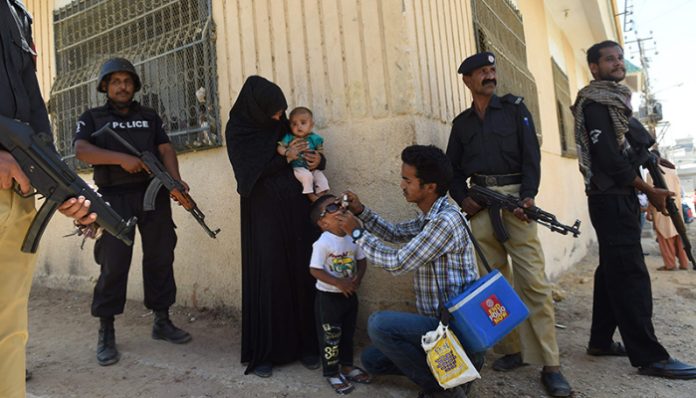
The Regional Reference Laboratory for Polio Eradication at the National Institute of Health (NIH) has confirmed two fresh cases of wild poliovirus, pushing Pakistan’s tally for 2025 to 23.
Officials said the new cases emerged in southern Khyber-Pakhtunkhwa (K-P), with one from District Tank and another from North Waziristan.
The affected children include a 16-month-old girl from Union Council Mullazai in Tank and a two-year-old girl from Union Council Miran Shah-3 in North Waziristan.
So far this year, K-P has reported 15 of the 23 total cases, Sindh six, while Punjab and Gilgit-Baltistan have one case each.
Health experts stressed that polio remains a highly contagious and incurable disease, which can cause lifelong paralysis in children.
They reminded parents that repeated doses of the Oral Polio Vaccine (OPV) during every national drive, along with complete routine immunisation, are the only proven safeguard.
Authorities expressed concern over the virus’s continued circulation in parts of southern K-P, blaming challenges in reaching remote areas and persistent resistance to vaccination in certain communities.
To counter this, both national and provincial Emergency Operations Centres (EOCs) are scaling up efforts to improve the quality of immunisation campaigns.
The National EOC has prepared a detailed vaccination plan for the coming low-transmission season.
The first nationwide campaign will run from September 1 to 7, followed by a focused drive in southern K-P starting September 15. Over 28 million children under five will be targeted through a door-to-door effort.
“The goal is to ensure that no child is left behind,” a senior official said, adding that “rapidly boosting immunity levels in high-risk areas is critical to interrupt transmission.”
A May 2025 report highlighted widespread refusals, including 17,136 in Peshawar, 10,781 in Bannu, 6,812 in Mardan, 2,128 in DI Khan, 1,009 in Kohat, and 976 in Lakki Marwat.
However, Shafiullah Khan, coordinator of the EOC in K-P, noted that media-led awareness campaigns are helping reduce refusals.
“Once there were thousands of refusals, now only a few areas remain, and efforts are underway to address those too,” he said.
He also pointed out that the lack of communication networks and ongoing security challenges in tribal districts continue to hamper eradication efforts.