

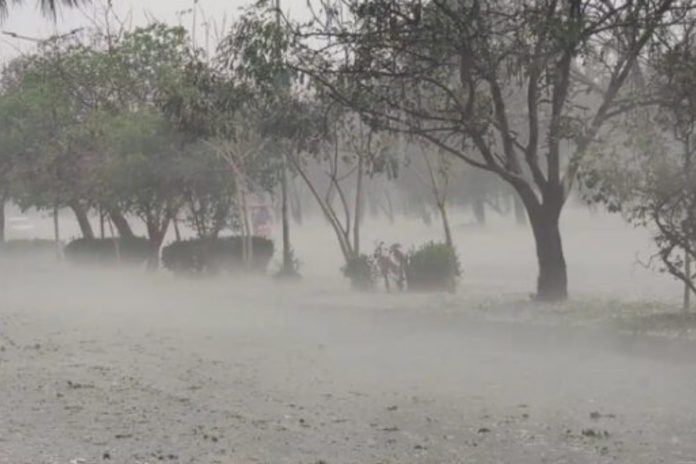
ISLAMABAD: More spells of rain are expected in Islamabad, Rawalpindi, and several other regions of Pakistan on Thursday evening, Thursday night, and throughout Friday.
As shared by the Pakistan Meteorological Department (PMD), a seasonal low-pressure system is present over northeast Balochistan, while moisture from the Arabian Sea is reaching the northern parts of the country. A westerly system is also active in these areas.
Given these weather patterns, further intermittent rain is expected in the twin cities, Kashmir, Khyber Pakhtunkhwa, upper and central Punjab, Gilgit-Baltistan, and northeast Balochistan during the mentioned period.
Some areas in upper Khyber Pakhtunkhwa could also experience isolated heavy showers.
There is a possibility of flash flooding in the hill streams of Dera Ghazi Khan and urban flooding in parts of northeastern and eastern Punjab due to intense rainfall.
In terms of temperatures, Islamabad is likely to see a high of 29 to 31°C on Friday and 30 to 32°C on Saturday. Rawalpindi’s maximum temperatures are expected to range from 30 to 32°C on Friday and 31 to 33°C on Saturday.
During the last 24 hours, rain along with isolated heavy showers fell in different areas including Islamabad, Punjab, Kashmir, Khyber Pakhtunkhwa, northeast Balochistan, and Gilgit-Baltistan.
Rainfall recorded in various areas was as follows:
Punjab:
Sargodha received 69 mm in the city and 41 mm at PAF Base. Noorpur Thal recorded 59 mm, Mandi Bahauddin 50 mm, Hafizabad 44 mm, Sheikhupura 32 mm, and Narowal 31 mm.
Other areas like Sialkot, Joharabad, Jhelum, Chakwal, Attock, Murree, Gujranwala, Shorkot, Mangla, Lahore, Kot Addu, Rawalpindi, Kamra, and Layyah received between 1 and 20 mm.
Khyber Pakhtunkhwa:
Mardan recorded the highest at 68 mm, followed by smaller amounts in Peshawar, Lower Dir, Kakul, Dir, Balakot, Pattan, Kalam, Saidu Sharif, Malam Jabba, and Bannu.
Balochistan:
Bar Khan received 29 mm, while Sibbi saw 4 mm.
Kashmir:
Kotli received 29 mm, with Garhi Dupatta and Rawalakot recording 6 mm and 3 mm, respectively.
Gilgit-Baltistan:
Gilgit received 5 mm, while Skardu and Chilas had 4 mm each.
Dalbandin was the hottest area in the country, where the temperature reached 46°C. Nokkundi and Dadu followed closely, recording highs of 45°C and 43°C respectively.
Islamabad’s highest temperature stood at 30°C with 78% humidity in the morning, while Rawalpindi also recorded a maximum of 30°C with humidity at 81% early in the day.