

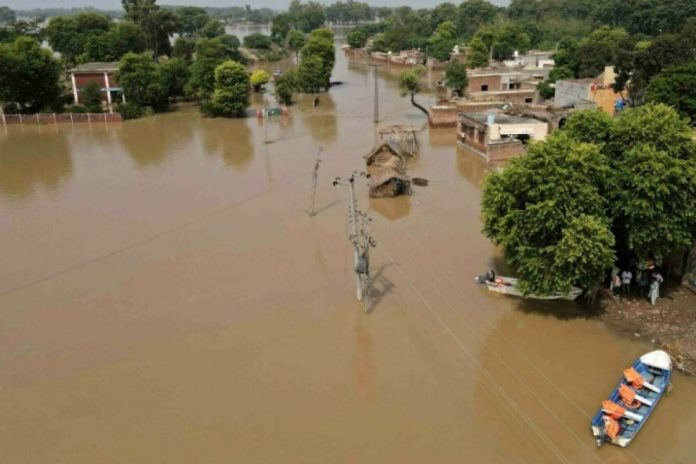
LAHORE: The Provincial Disaster Management Authority (PDMA) Punjab has announced a detailed rehabilitation plan for flood-affected families, confirming that special ATM cards will be provided to ensure transparent and efficient distribution of financial aid, as per the report.
PDMA said a damage assessment survey will begin tomorrow and continue until September 29 in 27 affected districts.
A total of 2,213 teams have been formed to cover 3,775 villages across Punjab. The survey will be conducted using digital forms and Android applications to maintain transparency.
Once completed, the data will be sent to Deputy Commissioners (DCs) and Assistant Commissioners (ACs) for verification before being forwarded to the Bank of Punjab.
After approval, the Bank will release financial assistance to families through specially issued ATM cards.
Victims whose data is rejected will have the option to appeal before the DC or AC. PDMA also shared that a high-level committee, with members from various ministries, has been established to oversee the process.
Under the compensation plan, owners of fully destroyed brick houses will receive Rs. 1 million, while owners of fully damaged mud houses will get Rs500,000.
Partially damaged brick houses will be compensated with Rs300,000, and partially damaged mud houses with Rs150,000.
The floods have also damaged 2,040 schools, one university, seven colleges, several THQ hospitals, and 79 healthcare centers, according to PDMA.
Earlier, PDMA provided an update on river water flow across Punjab. It stated that levels are normal in most rivers, except for the Panjnad, where a medium-level flood has been recorded.
The Indus River is flowing at 196,000 cusecs at Tarbela, 169,000 cusecs at Kalabagh, 178,000 cusecs at Chashma, and 161,000 cusecs at Taunsa, all at normal levels.
The Chenab is also stable, with 56,000 cusecs at Marala, 68,000 cusecs at Khanki, 75,000 cusecs at Qadirabad, and 80,000 cusecs at Trimmu.
At Panjnad, however, the flow has surged to 234,000 cusecs, causing a medium-level flood. Meanwhile, the Ravi River remains normal, with flows recorded at 8,000 cusecs at Jassar, 10,000 cusecs at Shahdara, 29,000 cusecs at Balloki, and 23,000 cusecs at Sidhnai.
PDMA noted that river conditions are generally stable, but monitoring teams remain on high alert around Panjnad to respond quickly if water levels change.