

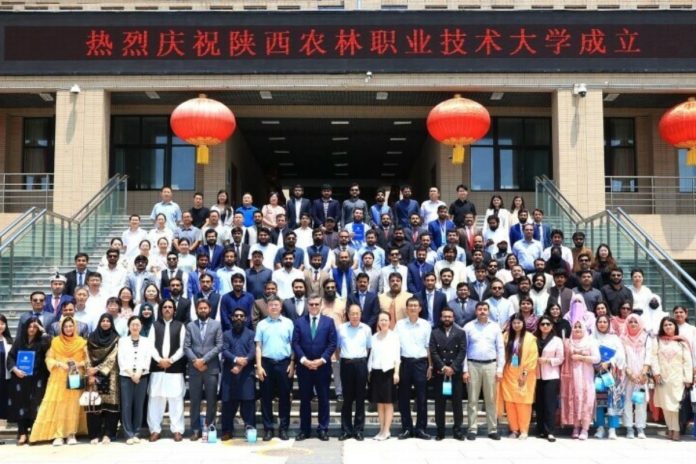
Prime Minister Shehbaz Sharif shared on Friday that the first group of 300 Pakistani agricultural graduates has successfully completed hands-on training in China’s Shaanxi province.
This milestone is part of a joint training programme between Pakistan and China focused on agricultural development.
Launched in July last year, the programme aims to send a total of 1,000 Pakistani students to China for in-depth vocational training in advanced farming methods, with all expenses covered by the government.
The first group began their training during the 2024–25 academic session. Future participants will receive Chinese language instruction in Pakistan before traveling abroad for training.
In a message posted on X (formerly Twitter), the Prime Minister expressed satisfaction with the initiative’s progress.
He highlighted that students received training in crucial areas like smart irrigation systems, seed development, livestock care, increasing farm productivity, and reducing waste after harvest.
He thanked the Chinese government, Shaanxi province authorities, and the partner institutions, North West Agriculture and Forestry University and Yangling Vocational and Technical College, for helping bring this initiative to life.
The Prime Minister also appreciated the role played by Pakistan’s Ministry of National Food Security, the Higher Education Commission (HEC), and the Pakistani Embassy in Beijing in supporting the programme.
The Chinese Embassy also posted a congratulatory note on X, commending the graduates and expressing optimism that they would contribute to Pakistan’s agricultural progress and strengthen cooperation between the two countries.
Earlier this year, Prime Minister Shehbaz had reiterated his government’s determination to modernise the country’s agriculture sector, calling it a key factor for sustainable growth.
Despite these ongoing efforts, the Pakistan Economic Survey recently revealed that the agriculture sector, making up nearly 25% of the GDP, only grew by 0.6% in 2024–25, falling well short of the 2% goal and much lower than the earlier 6.4% projection.
Major crops, including wheat, cotton, and maize, experienced a sharp decline, shrinking by 13.5%, far exceeding the forecasted 4.5% drop.