

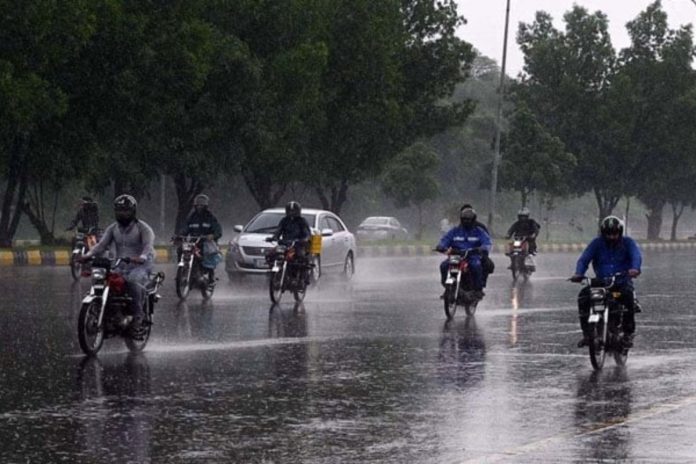
Pakistan’s weather department has issued red alerts in several provinces as strong monsoon systems are expected to cause flash floods, landslides, and waterlogging in cities through Tuesday, July 15.
The Pakistan Meteorological Department has warned that “heavy to very heavy rainfall” may lead to flash flooding in Khyber Pakhtunkhwa, Punjab, some areas of Balochistan, Kashmir, Islamabad, and Rawalpindi.
There is also a chance of hill torrents in Dera Ghazi Khan and mudslides in Gilgit-Baltistan. Strong winds may damage trees, electric poles, vehicles, and crops standing in the fields.
Although Karachi and many other areas of Sindh are not at immediate risk of flooding, they are expected to go through intense humidity and scattered thunderstorms.
Karachi’s temperature may range between 33 and 36 degrees Celsius, while humidity is likely to remain around 78 percent, making weather conditions more uncomfortable.
The department has predicted thunderstorms with rain in the evenings through the middle of the week.
Other districts in Sindh, such as Thatta, Sukkur, Jacobabad, and Larkana, may also see scattered rain and thunderstorms. Sukkur could see temperatures reaching as high as 44 degrees Celsius, while Thatta may get storms despite a relatively cooler 36 degrees.
A spokesperson from the Met Office explained that a strong combination of monsoon currents coming from the Arabian Sea and the Bay of Bengal, along with a powerful westerly wave, will bring widespread rainfall to many parts of the country. This weather system is expected to stay for a few more days.
In the past 24 hours, Okara recorded the most rainfall in Punjab at 72 millimeters, followed by Sahiwal with 66 millimeters and Dera Ghazi Khan with 51 millimeters.
In Khyber Pakhtunkhwa, places like Swat, Kalam, and Malam Jabba received steady rain. Major cities like Lahore, Rawalpindi, Gujranwala, and Peshawar are at risk of urban flooding.
Authorities have asked people to avoid unnecessary travel, secure weak structures, and be ready for emergency situations as monsoon conditions grow more severe across the country.