


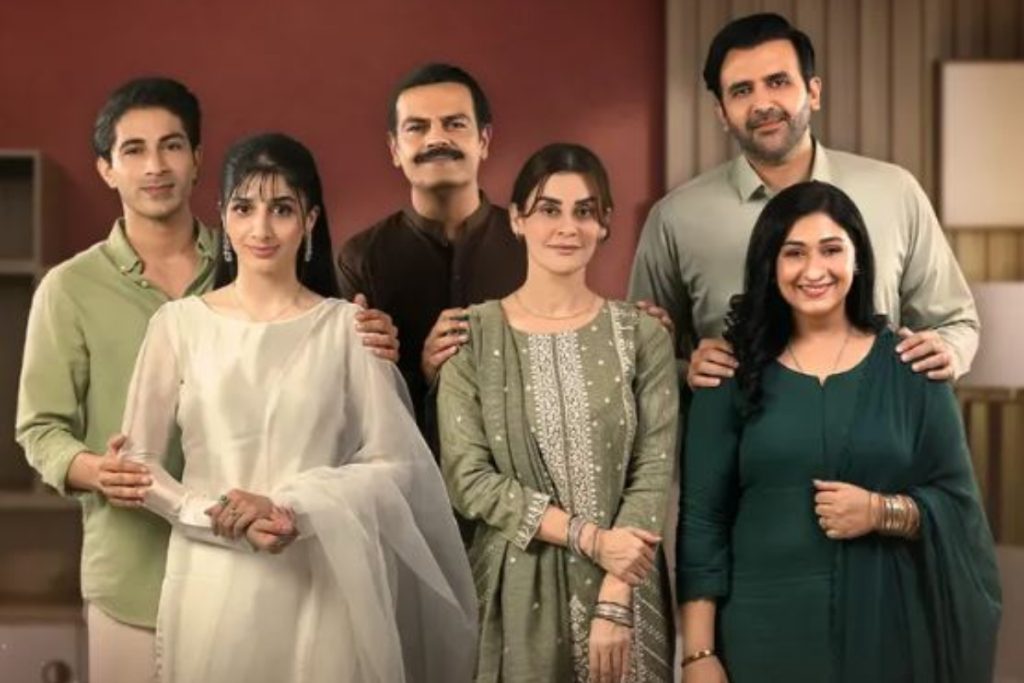
This particular play reminded the writer of Mannat Murad when it started airing, as the two productions in question had a number of similarities. Both had a female protagonist who was confident, self-assured and extremely vocal about what she wanted. Coincidentally, both had Talha Chahour as the male lead.
Both productions featured a couple who hailed from two completely different backgrounds and completely different family set ups. However, the similarities stop there as Jama Taqseem, thankfully did not follow the tried and tested path and through its tightly knit script and faultless execution, has managed to raise a number of pertinent issues.
Are joint family systems all they are made out to be? Are they obsolete or on the verge of becoming obsolete? Jama Taqseem raises a number of questions and gives the viewer plenty of food for thought. Laila (Mawra Hocane) hails from a nuclear set up and her parents are both working professionals. She meets Qais at university and they fall in love. However, Qais hails from a typical business family where all the brothers live together under one roof, in line with his parents’ wishes.
This play very cleverly looks at the pros and cons of joint family systems without being biased. It breaks a number of stereotypes, for example, although Mawra hails from a completely different background and is educated and modern (for want of a better word), she tries her best to adapt and is portrayed as a simple and loving individual who respects her in laws. Generally, it is assumed that educated and modern women are not home makers and fail to be good wives and mothers.
The topic of sexual harassment has also been raised, as one of the girls in the household is being harassed by her male cousin. When the truth is revealed, the boy in question is sent away. However, there are points in the play where it succumbs to the ordinary, for example, instead of worrying about the trauma the girl has experienced at the hands of her cousin and possibly considering seeking professional help for her, the grandmother is more worried about who will marry her and how her future will pan out.
When raising sensitive issues like sexual harassment, the idea of visiting a therapist for counseling should also be normalised as this will help remove the stigma around going to shrinks, as they are popularly referred to. Rather than worrying about the future prospects of the female, this is the time to give her love, care and affection and seek professional assistance to aid her in her recovery. This was a golden opportunity to talk about the benefits of seeking professional help in order to help the individual to come to terms with this trauma.
This play also highlights how parents in Pakistani households emotionally blackmail their children and lose no opportunity to make them feel guilty, if they choose to move out. Again, this has been very sensitively handled and Laila (Mawra), although initially labeled as the main culprit by her parents in law and blamed for breaking up the family roost, in a surprising turn of events, brings them to live with her. Quite contrary to what they believe, she is a compassionate and loving soul who in order to make her husband happy who misses his parents terribly, tries to mediate and urges them to move in with them.
Double standards are evident also, as Qais’s sister, Nudrat, lives independently, because according to him, they are extremely toxic. This does not stop her from harping on about the merits of joint family systems and she has no qualms about interfering in her sisters-in-law’s affairs.
Another issue that has been highlighted is that a girl looking after her husband’s parents is the perfect bahu but if she happens to extend the same courtesy to her own parents, then this is frowned upon. Laila is the only child and when her mother retires, she brings them to live with her but her parents-in-law take great objection to this arrangement. Very cleverly, these issues have been brought to the fore, thanks to the deft execution of the script and the tight grip that the writer has on the narrative.
Despite the loopholes, this is a tightly woven script and brings a lot of issues to the fore. Joint family systems might have a lot of pros but what this play highlights is that if living together is only making people miserable and leading to problems, then living independently might not be such a bad idea, if it helps to keep the family unit intact.
Do Qais and Laila finally manage to build bridges with Qais’s parents? Do they manage to ride out this storm also? Keep watching to see how the play pans out as it nears the end.
Let’s keep our fingers crossed!
The writer is an educationist and can be reached at gaiteeara@hotmail.com.