


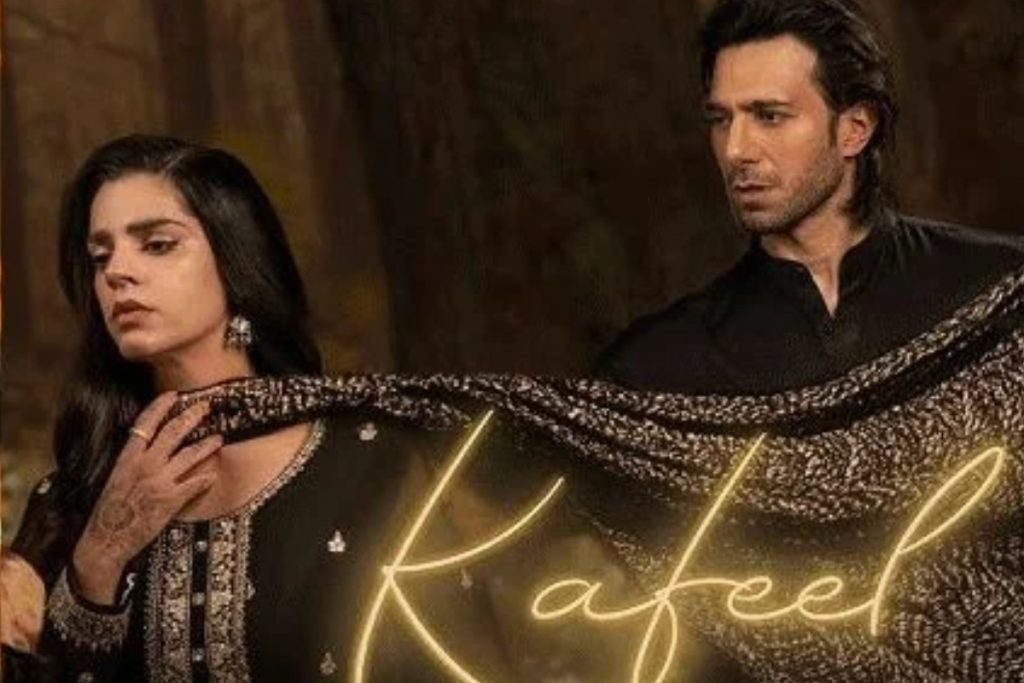
Umera Ahmad’s new offering, Kafeel, directed by Meesam Naqvi, is set in the 90s and is an accurate portrayal of how marriages were arranged in those days. As a member of Gen-X who grew up in the nineties, the first few episodes took me back to my teenage years, when life and tastes were simpler, and so were people.
Umera effectively captures a traditional middle-class family, where Sanam Saeed (Zeba) is the eldest and the apple of her father’s eye. Hailing from a traditional and conservative family with no exposure to the opposite sex, she has had a very sheltered upbringing where her world revolved around her college, books, friends, and her family.
A chance encounter with a member of the opposite sex sets her heart racing. He sings a song and pens a note for her with his number on it. When her mother discovers that note, she panics and decides to marry her off to her best friend’s brother, Jami. On the surface, everything looks perfect; he is handsome, charming, and apparently, extremely well – off. Without further ado, Zeba is married off.
Very soon, Jami starts showing his true colour,s and trouble starts brewing in paradise. He is not only extremely self-centred, but also very arrogant. He believes that he was born to enjoy life and repeatedly calls himself Raees and Khandaani, but has no qualms about sponging off his in-laws. The sense of entitlement and privilege he has is unbelievable to say the least.
He single-handedly destroys the business, sells off all the shops, and disposes of all the ancestral property. When Zeba’s father discovers the truth, he is devastated and realises his folly in blindly trusting his wife and acting in haste.
This play highlights how important it is to trust your daughters and how an overreaction to a simple gesture can destroy lives. Since Jami’s sister is Zeba’s mother’s college friend, she blindly trusts her and chooses to marry her daughter off to her brother, without making any inquiries about the family whatsoever. This backfires on them, and they marry off their daughter to a blood-sucking, arrogant loafer, who is a habitual liar and changes colours like a chameleon.
To make matters worse, his girlfriend arrives and regales Zeba with all the stories about their romance. All this highlights and underlines how important it is to do all the groundwork while considering a proposal. Trusting your daughters and having faith in your upbringing is also a must, rather than marrying them off to the first individual who comes along and then repenting later.
The father wants his daughter to get a divorce, but before they can visit a lawyer, things take an unexpected turn, which seals Zeba’s fate forever. What will happen now? Do we have another Durr-e-Shahwar in the making? Again, daughters are traditionally seen as a burden and a huge responsibility; this play highlights how sometimes, in a hurry to dispose of, we end up wrecking their lives. The family honour is inextricably linked to them, so Zeba’s mother, fearing that she might bring dishonor to the family, ends up marrying her off to a blood-sucking parasite.
She never bothers to ask her about the note clutched in her hand or delve deeper; instead of giving her the benefit of the doubt, she is convinced that the best solution to the problem is to marry her off to the first person who proposes.
However, that is only the beginning. Umera’s plays are extremely realistic, and the dialogues are very well-written. She is one of the most prolific writers in the television industry today. Sanam or Zeba, as the protagonist, portrays the plight of the majority of women from middle-class backgrounds, stuck in toxic marriages and forced to endure everything in order to avoid the stigma of divorce. Once they have children, there is no going back, and they spend their entire lives constantly compromising and enduring everything to maintain the farce of a happy marriage.
Despite the fact that things are gradually changing, there is still a huge stigma attached to divorce, whether we admit it or not. A play which recently concluded on GEO, Case No.9, also amplified this reality, where Saba Qamar, Sehar, plays a rape victim. As she is divorced, she is considered to be available and ready to fall into bed with the first man she comes across.
Unlike Zeba, Sehar is a highly educated, self-assured, and confident woman, who is raped because she had the courage to reject the sexual advances of a predatory boss, played by Faisal Qureshi. She pays the price but eventually emerges triumphant. The point is that even if divorced women are economically independent and confident individuals in their own right, the men around them still consider them to be available and sexually experienced, as opposed to their counterparts who are single.
That particular mindset is deeply rooted in our culture, which is one reason women are afraid to admit that they are widowed or divorced. The plight of a widow was also conveyed extremely convincingly by Saba Qamar in Pamaal, where everybody believes that she is public property and available, now that she does not have a husband by her side. Married women, in fact, even her brother-in-law’s wife, is not comfortable with the idea of her husband visiting his brother’s widow and points out that she is not his brother’s wife any longer, but a widow.
The presence of a husband in our society is supposed to give women a false sense of assurance and security. Whether it does or doesn’t is a topic that merits another article, but until then, let’s keep watching Kafeel and debating about whether Zeba will finally emerge triumphant in the end. Will her sacrifices and endless compromises pay off? Will Jami ever change, or will he continue to leech off his wife and her family?
Keep watching to find out!
The writer is an educationist and can be reached at gaiteeara@hotmail.com.