


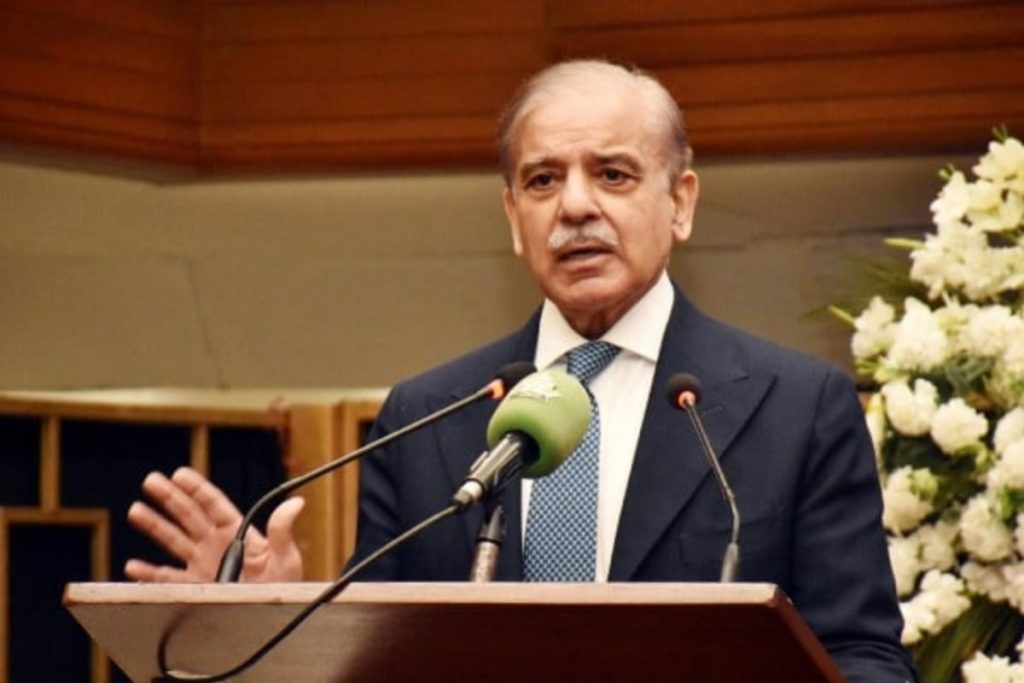
GILGIT: Prime Minister Shehbaz Sharif on Monday emphasized the need to set up an advanced weather alert system for tourist spots, based on seasonal predictions, and called for relocating communities away from natural waterways to avoid future disasters.
While chairing a meeting on recent floods and rehabilitation efforts in Gilgit-Baltistan, the prime minister stressed the importance of early warning systems, timely relief readiness, and building climate-resilient infrastructure in at-risk areas.
He directed the NDMA and the Ministry of Climate Change to work together and establish a forecasting and monitoring center for the region in the coming months.
He also called for a complete emergency response system for immediate rescue and relief operations.
The prime minister asked the NDMA to closely coordinate with provincial governments and all relevant agencies to improve rescue and aid efforts.
“All rehabilitation measures for those affected by the recent monsoon must be completed promptly,” he said. He instructed that a damage survey be conducted for roads and infrastructure, and that all affected communication routes be restored without delay.
He expressed deep sorrow over the loss of lives caused by heavy rains and flooding, and once again brought attention to Pakistan’s vulnerability to climate change.
He pointed out that although Pakistan contributes little to global emissions, it ranks among the countries most affected by climate-driven disasters.
“Despite Pakistan’s near-zero emissions, we suffer huge devastation every year due to global warming,” he stated.
The prime minister appreciated the efforts of rescue workers, including NDMA, PDMA, the Ministry of Communications, district administration, and other emergency responders, and directed NDMA to extend full support to the provincial government.
Officials from the provincial administration and NDMA briefed the meeting on the damages caused by monsoon rains, especially in Gilgit-Baltistan, expected weather developments, and actions taken so far.
The Ministry of Climate Change provided an update on the early warning system being installed for Glacial Lake Outburst Floods (GLOF).
According to the report, heavy cloudbursts on July 21, 2025, in Thak-Babusar, Thor, Kundus, and Ishkoman caused damage to both tourists and locals. More than 600 individuals were rescued, and road connectivity was restored after repairs.
Five tent villages were set up for relief efforts, and ten helicopters, along with two C-130 planes, were used to evacuate stranded people to safer places.
The operation was carried out with support from the Pakistan Army, NDMA, GBDMA, local authorities, police, Rescue 1122, and health workers.
The Ministry of Communications gave a briefing on the destruction of roads, bridges, and other infrastructure. The prime minister instructed that all reconstruction be carried out using climate-resilient designs.
The Ministry of Climate Change also shared updates on the GLOF warning system’s progress. The prime minister ordered that NDMA fully assist the ministry to ensure the system is operational within two months, and also called for third-party verification of its installation.
He further directed the Minister for Water Resources to stay in Gilgit-Baltistan and complete consultations for a stronger water management strategy.
The meeting was attended by Federal Ministers Engineer Amir Muqam, Abdul Aleem Khan, Attaullah Tarar, Mian Moeen Wattoo, Dr. Musadik Malik, Adviser Rana Sanaullah, PM’s Coordinator Shabbir Ahmed Usmani, Governor Gilgit-Baltistan Syed Mehdi Shah, Chief Minister Gulbar Khan, Chairman NDMA Inam Haider Malik, and other senior officials.